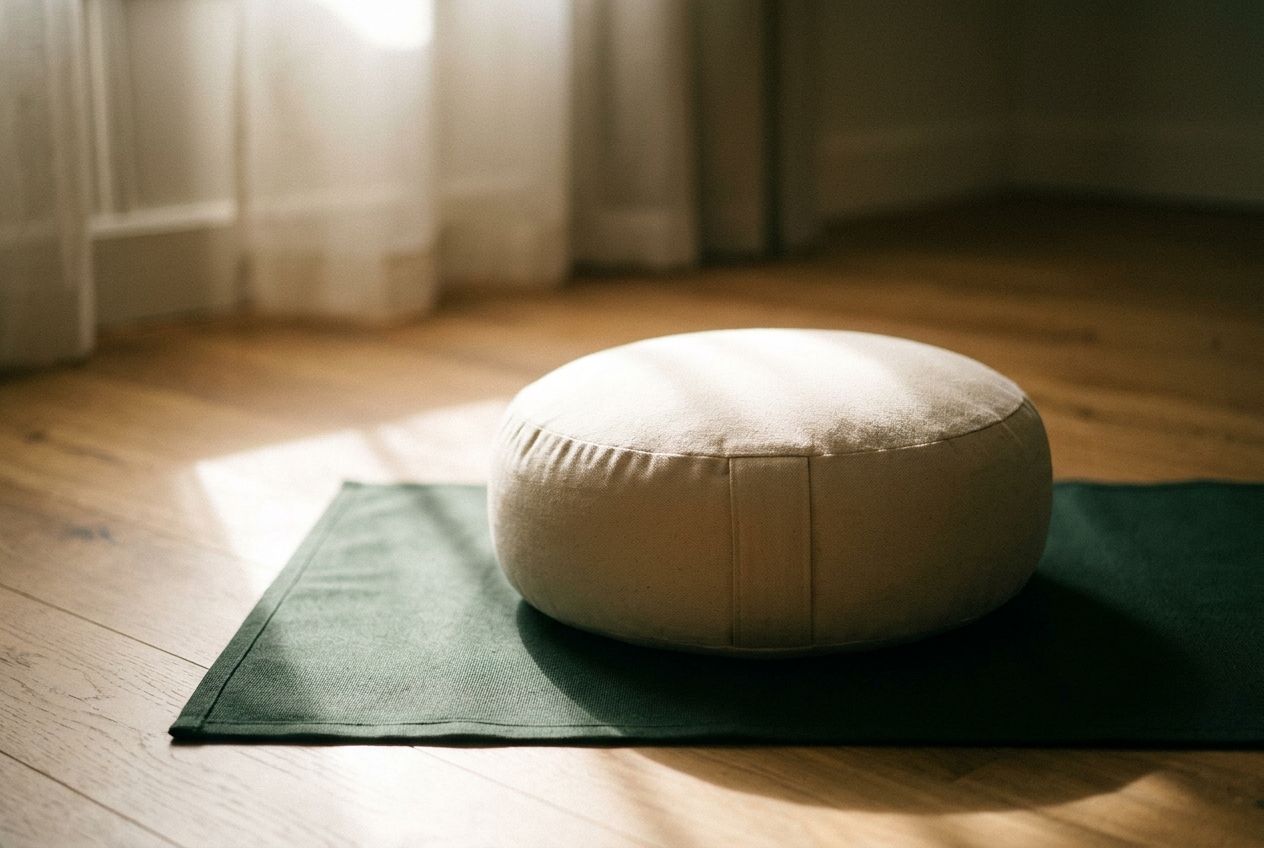
Meditation & teachings
Training the mind, opening the heart
From the Four Noble Truths to insight into non-self: the teaching and practice at the heart of the centre.

01 Dhamma
Authentic Buddhist philosophy
About 2,500 years ago the Buddha discovered the ultimate truth about existence and taught it through the Four Noble Truths: Dukkha (suffering), Samudaya (its cause), Nirodha (its cessation) and Magga (the path to its cessation).
Beyond the everyday suffering everyone knows lies a deeper, existential suffering bound up with the perception of a self. Understanding this clearly is the foundation of the path, and the centre's teaching bridges the Buddha's profound wisdom with modern understanding.
At the centre: Newcomers receive instruction in the philosophy first, and are welcome to ask questions before beginning practice.
02 Samatha Bhāvanā
Concentration meditation
Samatha bhāvanā develops a calm, steady and concentrated mind. It is practised at the beginning and end of each retreat day, sitting in any posture that is comfortable for you.
A settled mind is the ground on which insight can grow. From here, practitioners are guided onward into Vidarshana and Vipassanā.
03 Vidarshana · Vipassanā
Insight meditation
Vipassanā is the observation of each thought as it arises. Vidarshana is penetrative insight into how each thought is formed: seeing it break down into the vibrations that enter through the sense faculties.
Retreats work through four meditation objects (karmasthana), from seeing the external world as a mental construction to the direct experience of non-self, each explored through explanation, walking meditation and discussion.
At the centre: Insight retreats are designed for those who already understand the philosophy, and focus on applying it through practice.
04 Nibbāna
The threefold path of wisdom
The centre teaches that liberation of mind, Nibbāna, is reached through three stages of wisdom: theoretical understanding (Sathya Ñāṇa), practical application through meditation (Kruthya Ñāṇa), and spontaneous awakening (Kruthak Ñāṇa), in which wisdom arises naturally from the first two.
Rather than suppressing thought, the practice investigates how thoughts arise and pass away, so that the sense of self is understood rather than simply quietened.

05 Preparing body and mind
Relaxation activities
Fundamental breathing techniques calm the nervous system and prepare the mind for deeper concentration. Systematic relaxation releases physical and mental tension.
Gentle, meditative yoga unites body and breath, building the physical stability and mental focus that sustained insight practice needs. Sessions are tailored to all experience levels and led by qualified instructors.
Begin where you are
A five-minute breathing practice
You can start today, wherever you are. This simple sitting is a gentle introduction. Practising with a teacher will take you much further.
Settle
Sit comfortably on a cushion or chair, with your back upright but not stiff. Let your hands rest and your eyes close or soften.
Arrive
Notice the weight of the body and the sounds around you. There's nothing to fix and nowhere else to be.
Breathe
Rest attention on the natural breath, at the nostrils or the belly. Don't control it; simply feel it come and go.
Return
When the mind wanders, and it will, notice where it went and gently come back to the breath. That moment of returning is the practice.
Close kindly
After a few minutes, widen your attention, wish yourself and others well, and carry a little of that stillness into your day.